
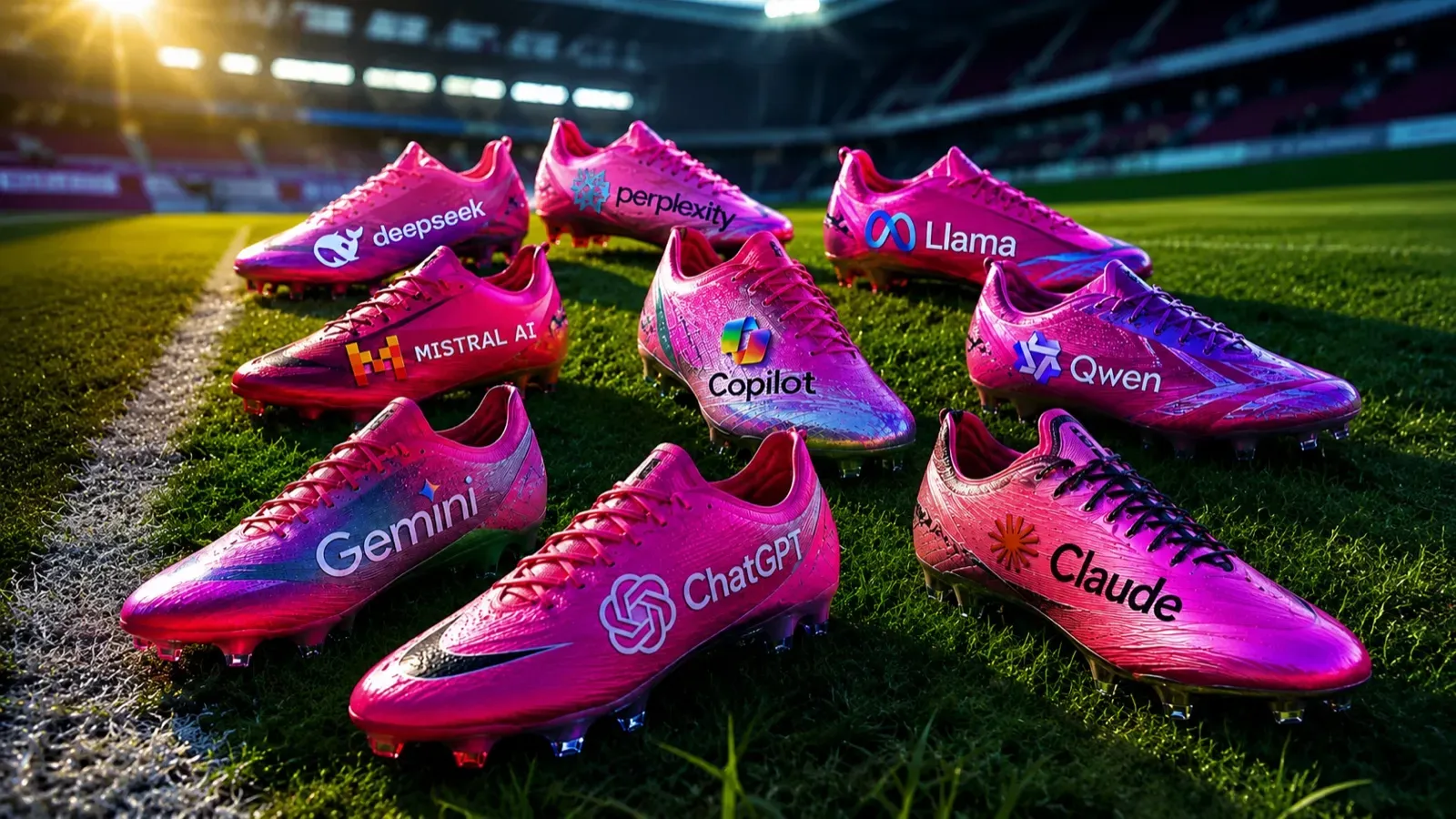
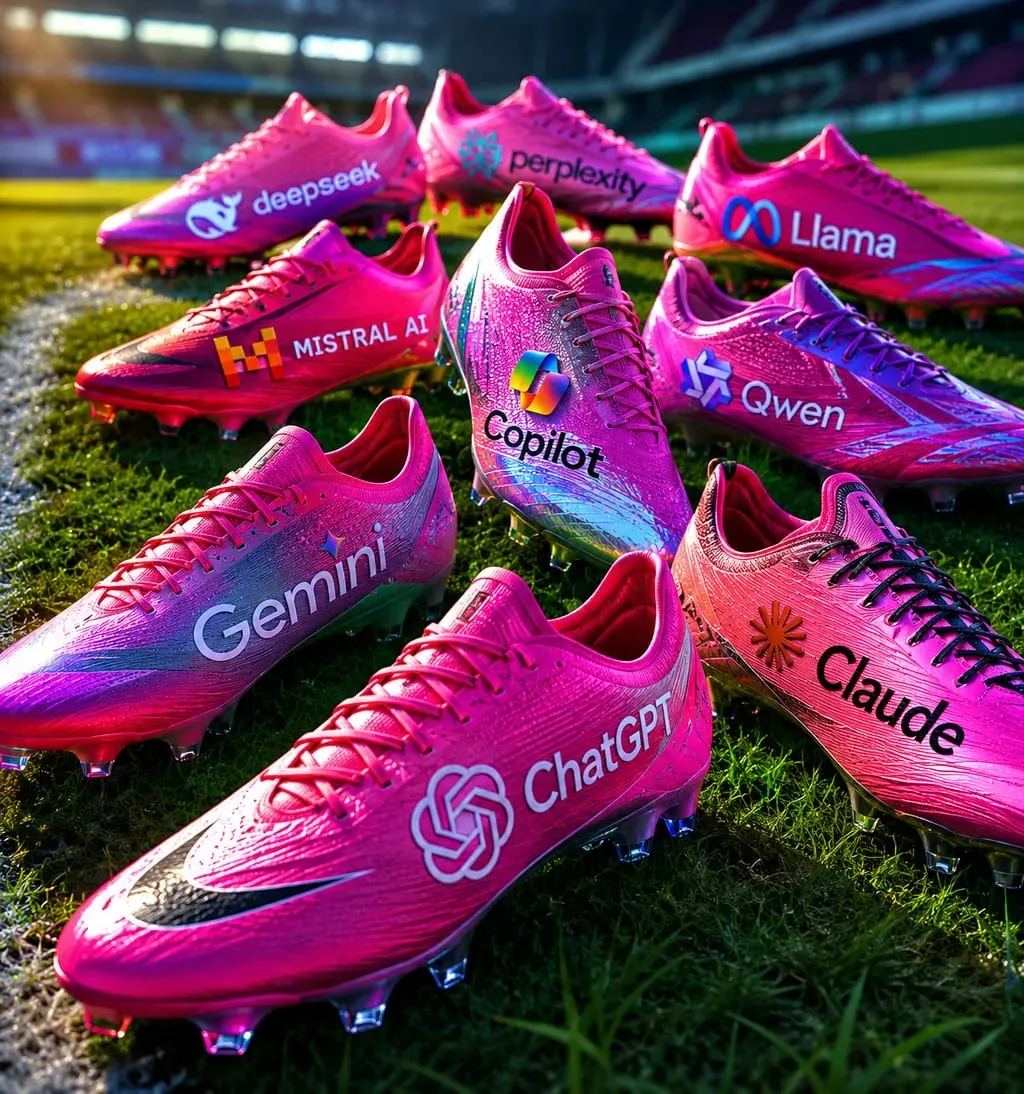
Don’t pick the pink boot for your company
In the 2026 World Cup almost every player wore the same pink. Not a generic pink — the exact same fuchsia. Nike launched “Breakout”, Adidas “Road to Glory”, Puma “Showtime”, with New Balance and Skechers following suit. Five fierce rivals, the same season, all dressing their athletes in the same color. No cartel, no secret meeting — something quieter and more unsettling.
Years earlier, the trend-forecasting agency WGSN had called “Electric Fuchsia” the color of summer 2026. Each manufacturer, in its own room, with its own designers, reading the same reports and the same consumer data, independently reached the same conclusion. This phenomenon has a name worth keeping: convergence. It did not start with AI — for decades, companies converged because they drank from the same sources: the same research, the same consultancies, the same cases, the same gurus.
Summary
WGSN is that intermediary in the world of color. The pink boots are what happens when it works too well. Now hold that image and swap the intermediary.
AI as the universal intermediary
WGSN advises on color — it is expensive, specialized, serving a limited set of clients. Now imagine an intermediary that advises on everything, costs almost nothing, is available to any company of any size in any sector, around the clock, and that millions of professionals consult daily — often without realizing they are consulting the same advisor as the competitor across the street. That intermediary exists: generative AI models.
When a copywriter asks for a headline, a strategist for a campaign plan, a designer for a visual concept, a manager for a market analysis — the overwhelming majority are asking a small handful of models: ChatGPT, Claude, Gemini, Copilot. Different models, yes, but trained on similar knowledge bases, optimized for similar objectives, filtered by the same probabilistic tendencies. Ask them all the same thing and you get, with surface variations, answers that rhyme.
What is Synthetic Consensus (Convergência Artificial)
Synthetic Consensus is the phenomenon by which brands, agencies and professionals who consult the same artificial intelligences arrive at the same conclusions, the same trends, the same campaigns and, in the limit, the same products. The consequence is mechanical, not conspiratorial: when millions of people consult similar intelligences, trained on similar data, there is a natural gravity pulling every decision toward the same center.
The professional in São Paulo and the one in Munich, asking similar questions to the same model, receive similar guidance — and act on it. The pink boot stops being an isolated case of color and becomes the portrait of how entire markets can begin to think alike, at scale, about anything.
The average-quality paradox: algorithmic monoculture
AI is not making anyone worse. It is making almost everyone a little better — and that is exactly the problem. AI lifts the average quality of decisions: text comes out cleaner, plans more coherent, analysis more organized. The tide rises and lifts all boats. For individual work, great news. For the market as a whole, a trap — because the same force that raises average quality compresses variation.
Recent studies of people writing with and without AI found exactly this: each author individually produced more interesting text, but the body of texts grew more similar to one another. More AI-assisted volume, more sameness. It is algorithmic monoculture — a field where everything grows well because the same optimized seed was planted, and where a single blight wipes out the whole harvest because no genetic diversity survived. Take ten company sites in your sector, strip the logos and names, read only the text. Can you tell who wrote what? If not, you just watched Synthetic Consensus at work.
The convergence of demand and the Share of Model
So far we spoke of the convergence of supply — how creators look alike. That is the half the market already discusses, the “sea of sameness”. But there is a second convergence almost nobody is talking about: the convergence of demand. Buyers used to type into Google and get ten links to sift through. Now they increasingly ask the model: “what is the best supplier of X for my case?” — and the model does not return a list. It returns a synthesized recommendation, a handful of names, often the same names, query after query.
This share is not a side effect of good traditional SEO. Models do not rank pages by counting keywords and links — they synthesize the most reliable answer from the repetition and consistency with which a brand is cited by independent, respected sources. Authority is not bought with volume of owned content; it is built when trusted third parties speak of you, consistently, over time. The real contest moved from “is my page well ranked?” to “when the machine recommends someone in my sector, does it say my name?”
The competitive edge of the future: knowing when to disagree
The competitive edge of the future will probably not be in using AI — not because AI does not matter, but for the opposite reason. It will matter so much, and be so universally adopted, that using it will no longer differentiate anyone. Using AI will be like having electricity in the factory: indispensable and utterly banal. Nobody wins an edge by having light; they win by what they do with it.
The real edge lives in two places. First, knowing when to disagree with the machine: when the model hands you the statistically safe answer, it is by definition handing the same answer to your competitor. Consensus is comfortable and that is exactly why it does not differentiate. Second, using AI itself against convergence: the smartest companies will turn AI into a map of the consensus — asking the machine what everyone is doing, what the default recommendation is — precisely to know where to deviate from. The compass that points the north everyone follows, so you can deliberately choose another direction.
Back to the pitch: the authority to ignore the trend
In the middle of the fuchsia sea, some feet refused to join. Messi went out in white and blue. Pulisic, in white. Ronaldo prepared a golden model. Not because those colors are better than pink, but because, in an environment where everyone converged on the same choice, the only way to be seen was not to converge. The spotlight did not go to whoever nailed the trend — it went to whoever had the authority to ignore it.
That is what is at stake for your brand. Not whether to adopt AI — that is already decided for everyone. The question is what you will do when you notice the machine is giving you the same advice it gave your competitor. Follow it, comfortable and invisible? Or use it as a starting point to find the path no one else is seeing? Perhaps the greatest challenge of the AI era is not building machines that think like humans — it is preventing all humans from thinking like the same machines.
Want to stop sounding like everyone else?
We map the AI consensus in your market and design the deliberate deviation — so your brand is the name the machine recommends, not just another pink boot.